EthStorage 2025 Annual Report

1.Core Technical Developments & Milestones
EthStorage Mainnet Alpha Live on Ethereum
After nearly three years of research and development, EthStorage Mainnet Alpha went live on Ethereum. The launch delivers petabyte-scale, verifiable storage as a dedicated layer 2, making long-term on-chain data both practical and affordable.
With this milestone, Ethereum’s modular vision becomes more complete. This unlocks fully on-chain games, AI models, social apps, and more at Web2-like scale with Web3 security.
GoE (Git-on-Ethereum): A New Application Built on EthStorage
In 2025, EthStorage enabled the development of GoE (Git on Ethereum), a decentralized Git protocol built directly on top of EthStorage. GoE introduces a new approach to trustworthy, on-chain code hosting by anchoring Git repositories and their history in a verifiable and censorship-resistant storage layer.
With GoE, developers can continue to use familiar native Git workflows—such as clone, push, and pull—while repository data, commit references, and history records are stored in an immutable on-chain environment. This demonstrates that EthStorage is capable of supporting complex, stateful developer workflows and redefines code ownership and long-term availability.
ethfs-cli Updates
ethfs-cli is a command-line tool that enables developers to upload content directly to Ethereum and EthStorage. It is primarily used by dApp developers to deploy frontend assets on-chain and access them via web3:// compatible gateways.
Following the Fusaka upgrade, Ethereum introduced changes to its BLOB proof generation mechanism. In response, ethfs-cli was updated to generate BLOB cell proofs locally, ensuring compatibility with the new protocol requirements. At the same time, upload performance was improved through pipelined processing, which reduced end-to-end deployment latency and enhanced the developer experience.
These updates further strengthen ethfs-cli as a practical deployment tool for on-chain frontends and large asset publishing.
Pre-Mainnet Foundations: Trusted Setup & Sepolia Testnet
By late August, the V1 Trusted Setup Ceremony was successfully completed. This completion established the cryptographic foundation of EthStorage’s proof system, paving the way for both testnet and mainnet deployment.
Shortly after, EthStorage launched a new Sepolia testnet that uses the newly generated Groth16 proving key and an audited storage contract, enforcing the same miner rules as Mainnet Alpha (whitelisted miners).
Super World Computer Beta Testnet with EthStorage as L3
The Super World Computer (SWC) Beta Testnet went live, with EthStorage integrated as the L3 storage layer. For the first time, this stack demonstrates up to 10,000x cost savings compared to L1 while keeping Ethereum’s security guarantees.
This launch marked a concrete step toward scalable, verifiable on-chain storage, positioning EthStorage as the storage backbone of the Super World Computer vision.
2. Research & Ethereum Contributions
Over multiple years, the team has actively participated in Ethereum’s core research that directly informs the protocol’s evolution. This work, with the collaboration of QuarkChain, spans foundational standards such as ERC-4804/6860 (web3://), protocol proposals including EIP-7907, EIP-7923, and early conceptual work related to block-level access lists, as well as hands-on client contributions with over 160 merged commits to Geth and op-geth.
EIP-7907: Dynamic Gas Metering and Larger Contracts — a Key Candidate for the Glamsterdam Upgrade
EthStorage explained EIP-7907, a key candidate for the Glamsterdam upgrade. Historically, developers were constrained by Ethereum’s 24 KB contract size limit, forced to split complex applications across multiple contracts, increasing complexity and bug risk.
EIP-7907 removes that hard cap, raising the limit up to 256 KB and introducing dynamic gas metering so larger contracts pay proportionally for code loading. This preserves security and scalability while dramatically improving developer experience for richer on-chain applications.
Geth Storage Architecture Deep Dive
EthStorage published a deep technical analysis of the Geth storage architecture, providing a six-layer breakdown—from the underlying databases to the state Merkle tree—and examining how these components work together to handle massive amounts of Ethereum state data. The analysis also explains how fast-access storage is separated from historical data through the freezer design, offering one of the most in-depth public explorations of Geth’s internal structure.
3. Ecosystem Partnerships & Incubation
Fracton Incubation Cohort 4 Mentor & Partner
Qi Zhou was welcomed as a mentor for Fracton Incubation Cohort 4, and EthStorage joined as a program partner. Selected teams gain access to mentoring directly from EthStorage core members.Through this collaboration, EthStorage supports early-stage projects with guidance.
Strategic Collaboration with ETHPanda
EthStorage highlighted its ongoing collaboration with ETHPanda, a China-focused non-profit that Vitalik Buterin has called a “great example” of community building in the ecosystem. EthStorage co-hosted multiple workshops and events with ETHPanda, strengthening ties with one of the most active technical groups in the region.
Partnering with Pieverse to Bring x402b Payments to web3://

EthStorage announced that Pieverse’s x402b payment system was being brought onto web3://. This is an important step toward payment rails that no longer depend on Web2 gateways or choke points.As x402b grows into a broader payment standard, decentralized access becomes essential —truly decentralized payments require equally decentralized frontends, and web3:// is how this future takes shape.
4. Media Coverage & Articles
4.1 Media
Cloudflare & AWS Outages Highlight the Need for End-to-End Decentralization
Cointelegraph covered two major outage events—AWS outage article and later Cloudflare outage article—both of which took multiple Web3 services offline. In each case, EthStorage was cited, explaining that decentralization cannot stop at consensus or smart contracts: access, routing, DNS, and storage also need to be decentralized.
EthStorage stressed that true resilience requires rethinking the entire stack and gradually removing centralized components to eliminate single points of failure.
4.2 AMA
PEEPanEIP Session on EIP-7907
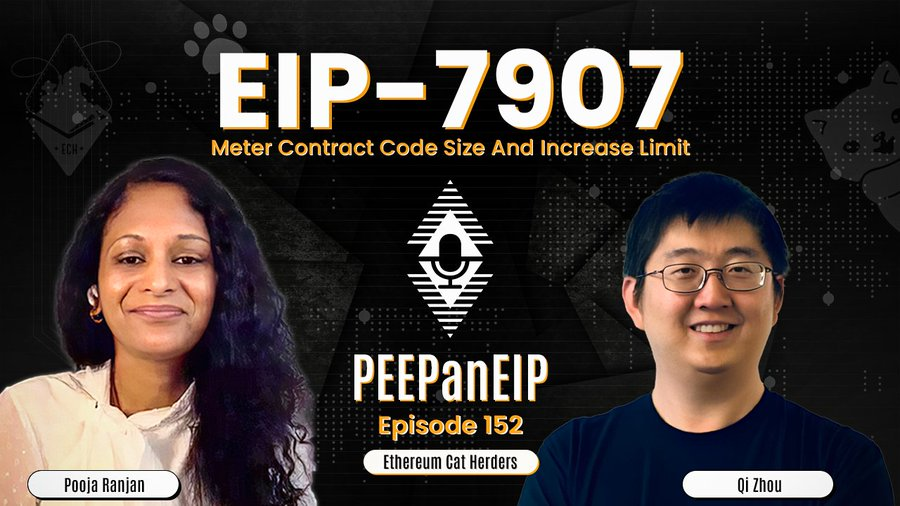
EIP-7907 was spotlighted on the PEEPanEIP series. EthStorage shared a clear summary of how the proposal lifts the 24 KB contract limit and introduces proportional gas costs for larger contracts.The session helped developers understand EIP-7907 in practical terms—why it matters for complex applications, how it improves safety, and what it means for the future of contract development on Ethereum.
Bybit Attack Online Discussion (EthPanda)

EthStorage joined the Bybit Attack Online Discussion organized by EthPanda, focusing on frontend security risks and the importance of access-layer decentralization in preventing single points of failure.
OKX Ventures AMA — “Ethereum Upgrades & the Road Ahead”

EthStorage participated in the OKX Ventures AMA – “Ethereum Upgrades & the Road Ahead”, where the team shared perspectives on the Pectra upgrade and the role of long-term data availability in Ethereum’s future roadmap.
AITOPIA X Space — “When the Internet Breaks: Can Web3 Survive a Cloudflare-Scale Outage?”
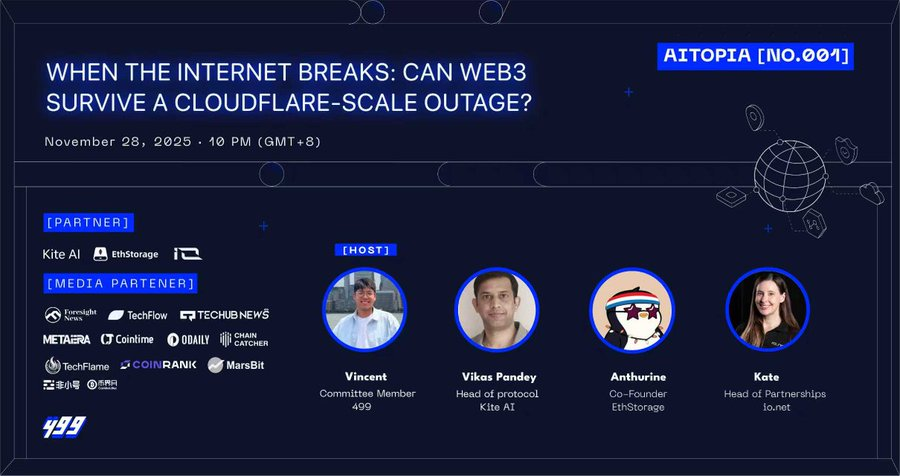
EthStorage participated in the AITOPIA X Space discussion “When the Internet Breaks: Can Web3 Survive a Cloudflare-Scale Outage?” The conversation explored end-to-end decentralization and how technologies such as web3:// and decentralized storage can eliminate single points of failure across today’s Web3 stack.
Podcast: “Re-examining Ethereum – Why Be Bullish on ETH Now?”
In a podcast episode focused on re-examining Ethereum, EthStorage’s founder discussed why Ethereum still deserves a cautiously bullish outlook. The conversation covered long-term idealism in the roadmap, perceived shortcomings of the layer 2-only scaling narrative, competition from other chains, and recent signs of reform, such as performance-focused changes and organizational restructuring.
4.3 Articles
Lessons from the Pectra Testnet Upgrade Incidents
The EthStorage team wrote a detailed summary of the Pectra upgrade issues. The thread walked through empty blocks, the customized staking deposit contract with token-gated logic, and how ERC-20 events conflicted with assumptions in the deposit contract, leading to network instability.It also described how client teams coordinated emergency fixes, reverted problematic transactions, and mitigated attempted attacks in real time. The takeaway: even testnet upgrades demand extreme caution, given Ethereum’s systemic importance and the community anxiety that any instability can trigger.
Lens Chain’s Grove vs EthStorage: A 7-Dimensional Comparison of Decentralized Storage Solutions
A detailed comparison was published between Grove on Lens Chain and EthStorage. Grove was described as off-chain data storage optimized for low cost and Web2-like performance, with centralized indexing and access control, while EthStorage was positioned as an Ethereum layer 2 solution that is fully decentralized, permissionless, with on-chain indexing and built-in storage incentives.
Unlocking Decentralized Storage: Which Solution Holds the Key?
In an article titled “Unlocking Decentralized Storage: Which Solution Holds the Key?”, a comparison of Arweave, Filecoin, Walrus, and EthStorage evaluated pricing, permanence, redundancy, and data accessibility. EthStorage was introduced as an Ethereum-native storage layer 2 with one-time “indefinite” costs and high redundancy (around 5000 replicas), well-suited for long-term, verifiable on-chain data.
Explaining Frontend Attacks and Why web3:// Matters
EthStorage’s founder broke down the $1.5B Bybit attack, showing how centralized DNS and servers expose dApp frontends—even when smart contracts remain secure—demonstrating that Web2-based infrastructure leaves the UI as a critical attack surface.
In another post explaining the core issue and why web3:// matters, the team highlighted that reliance on centralized components is the root problem, and that hosting frontends directly on-chain with web3:// makes updates verifiable, preserves permanent history, and removes DNS as a single point of failure.
This analysis was reinforced by multiple DNS incidents throughout the year—including the Aerodrome incident and the Curve Finance incident —which showed that even perfectly secure smart contracts cannot protect users if frontends depend on Web2 DNS and hosting. EthStorage pointed to web3:// (ERC-4804) as a permanently online, on-chain access protocol that eliminates DNS as a single point of failure.
5. Global Offline Events
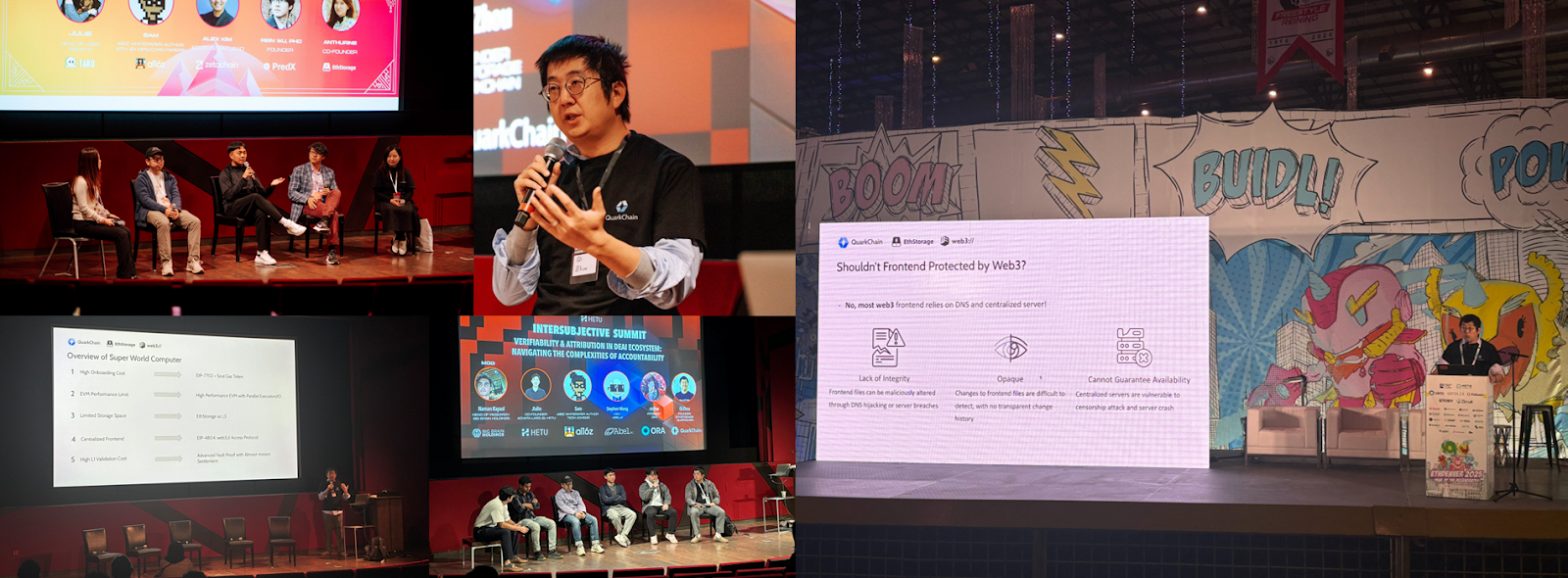
Across Asia, EthStorage was active throughout the year, speaking at major Ethereum weeks and regional ecosystem gatherings. In Korea, EthStorage presented at EthSeoul and later, during KBW 2025, hosted its own Super World Computer 2025 event featuring leading ecosystem projects.

Following that, EthStorage took part in multiple KBW side events in speaking, panel, hosting, and partner roles, including The Verified Summit, Depin X AI, Web3 AI Seoul, Story Station, Builder Nights.
In China, EthStorage contributed to Ethereum Summer Hangzhou, Summer of Ethereum Shanghai, ETH Shenzhen, ETHShanghai, and Ethereum Protocol Day Shenzhen, sharing updates on decentralized storage, EIP-7907, and the Super World Computer vision. The team also joined ecosystem activities during the Hong Kong Web3 Festival, including Ethereum Portal Summit, ZKConnect, ChaosChain Meetup, ETH Maxi Reunion Standup, and Meme Zoo Happy Hour.
In Singapore, EthStorage joined side events around Token2049 Singapore, including Deep Intelligence Ethereum, pre-Token2049 meetup, and The Scaling Summit.

At EDCON Osaka, EthStorage founder Qi Zhou delivered “Beyond EIP-4844: Designing Modular BLOB Storage for Ethereum’s Future Applications,” highlighting scalable, cost-efficient on-chain data availability. The team also joined the panel “Reinforcing Web3: Infrastructure Developments for a Seamless User Experience” at Taipei Blockchain Week.
Outside Asia, EthStorage presented technical research at EthPrague—including work on EIP-7907. The team spoke at the EthDenver main conference, participated in developer meetups and conference sessions, joined the Intersubjective Summit, and the Scaling DeAI Summit, and hosted a private VIP dinner. The team also joined the AI for Science x ChaosChain panel at EthSF and participated in Devconnect 2025, connecting with builders for insightful discussions.
To learn more about EthStorage and connect with our community, visit our community channels:
- EthStorage Website: https://ethstorage.io/
- Twitter: https://x.com/EthStorage
- Discord: https://discord.com/invite/xhCwaMp7ps
- Telegram: https://t.me/ethstorage